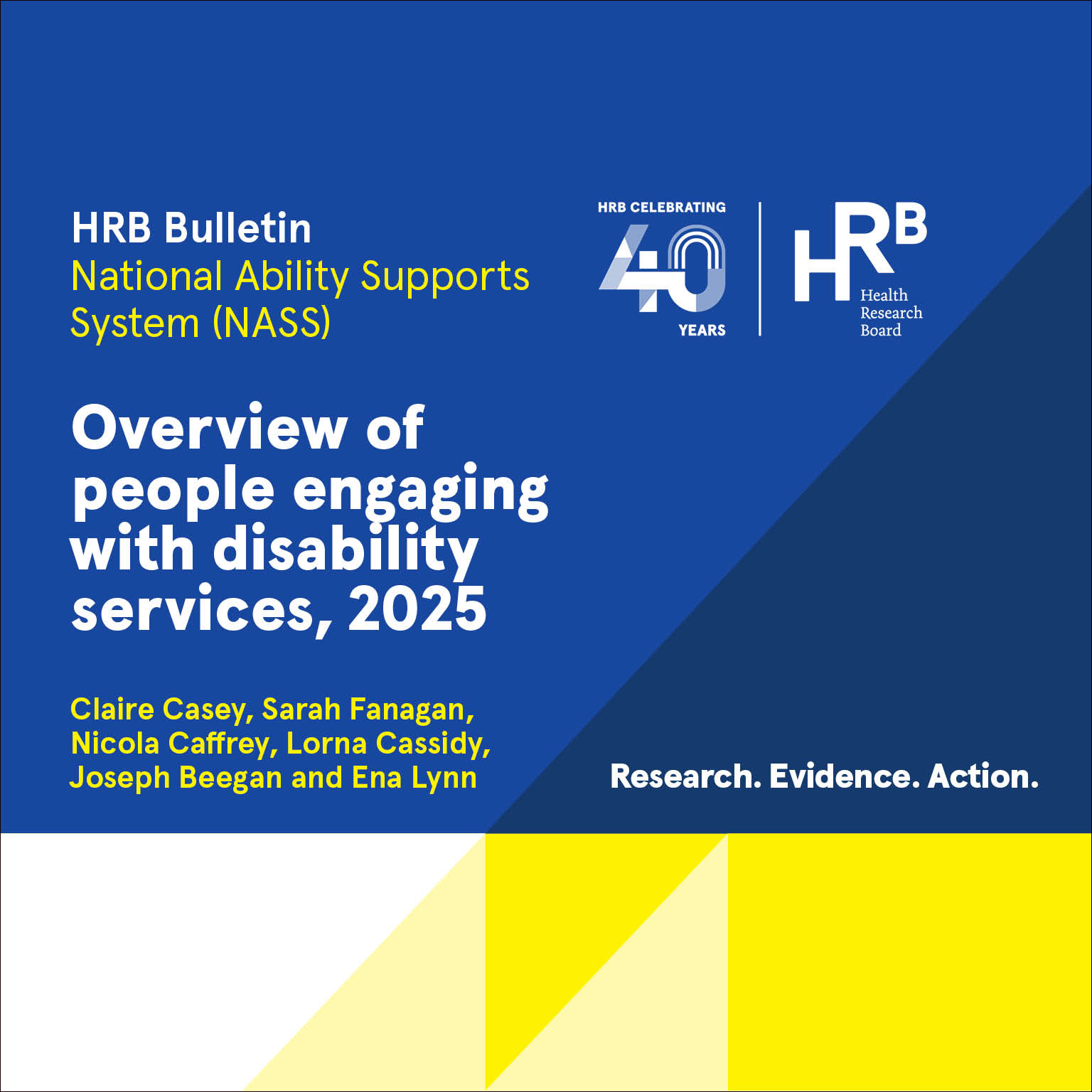
A new Health Research Board (HRB) report based on data from our National Ability Supports System (NASS) shows that 38,288 adults engaged with Health Service Executive (HSE)-funded disability services in 2025*. This represents a 10% increase from the 2024 figure of 34,652.
Commenting on the report, HRB Chief Executive Dr Gráinne Gorman said:
“The Health Research Board collects and reports on disability services data annually. This allows us to monitor trends and better understand how the needs of people living with a disability and their carers change over time. This actionable evidence is then used by policy makers and service planners for future allocation of resources and design of services in a way that best meets the needs of the people requiring them.”
One in 10 adults receiving disability services are Autistic, over one in two of whom are aged 18-24. This is the highest number of Autistic people ever reported and will impact the types of services needed in the future.
Overview of service users and carers
Nearly one in five (6,667) adults engaged with disability services are aged 18 to 24 and more than one in three (13,336) are aged 40 to 59.
More than half of adults (19,490) engaging with disability services have an intellectual disability. Nearly one in five of these are aged 60 years and over, and 227 are aged 80 and over. The data shows that service users with an intellectual disability are living longer. This highlights a need for age-appropriate services.
Among adults who did not live in a residential care setting, more than three in five (17,129) reported having a primary carer, almost all of whom (92%) live with them. Age range was recorded for 83% of carers. Nearly two in five primary carers are aged 60 years and over, with 10% (516) of these aged 80 years and over.
Current service provision
A total of 8,340 people across Ireland live in residential care, and the majority (97%) are adults. In 2025, 6,021 people accessed 151,446 nights of respite. Home support was received by 6,595 people, while 2,255 people had a personal assistant (PA).
Nearly two-thirds (24,222) of adults received at least one support service from either a multidisciplinary team or a specialised disability service. Day services were accessed by 20,717 adults. 91% of these were day programmes.
New services required 2025-2030
2,197 people require a residential place, the majority (83%) are adults and nearly three in four of these places are required immediately.
An additional 706 people require home support and 200 people require a PA. Over one in 10 (4,669) adults require at least one support service from either a multidisciplinary team or a specialised disability service.
The support services most commonly required are occupational therapy (1,209), physiotherapy (1,103), speech and language therapy (710), and clinical psychology (673).
Dr Claire Casey, Research Officer at the HRB and lead author of the report, said:
“This report from the Health Research Board highlights the growing need for residential care in Ireland. Data shows 2,197 people were identified by service providers as requiring a residential place, with three in four of these required immediately. The majority of people who require a residential place have an intellectual disability, are getting older, and have ageing carers looking after them.”
Ends
NOTE TO EDITORS
* This report does not capture data on waiting lists.
**The report focuses on data about adults receiving any HSE-funded disability services and children receiving HSE funded residential, respite, home support and/or specialised support services from dedicated organisations.
The number of children registered on NASS in 2025 has increased substantially compared to 2024. This is as result of information being provided to NASS from the HSE’s dedicated children’s case management system (CDNTIMS). There were 61,570 children in contact with a Children’s Disability Network Team (CDNT) in 2025. This includes children whose referral assessment for a CDNT is underway, children who are on a CDNT waiting list, are currently receiving services from a CDNT and children who have been discharged from a CDNT in 2025. Due to the ongoing roll out of the CDNTIMS in 2025, information on specialised support services for children is incomplete, therefore, data on support services are only presented for adults.
About the HRB
The Health Research Board (HRB) is Ireland’s lead funding agency supporting innovative health research and delivering data and evidence that improves people’s health and patient care. We are committed to putting people first, and ensuring data and evidence are used in policy and practice to overcome health challenges, advance health systems, and benefit society and economy.
About NASS
The National Ability Supports System (NASS) is a national database which records information about the HSE-funded disability services that people use and need such as residential services, respite care, day services and specialist supports, for example occupational therapy or physiotherapy. The purpose of NASS is to gather information from service providers to aid the planning, development, and organisation of HSE-funded disability services. A person is eligible to be registered on NASS if they receive or require (either currently or within the next five years) a HSE-funded disability service as identified by their service provider.
Data is provided to NASS by service providers who provide HSE-funded disability services to people in Ireland. Service providers are asked to ‘review’ NASS records for each of their service users at least once a year to ensure information is accurate for each reporting year.
Increased coverage of the data provided to NASS is as a result of ongoing engagement with the HSE and service providers.
Learn more about the HRB’s work in the area of disability service use and need